Booom: Injecting Explosive Energy into Your Visuals
If you have ever found yourself staring at a flat layout, wondering how to give it a pulse, you are likely missing a typeface with genuine personality. Enter Booom. This is not just another font file sitting in your library; it is a statement piece. As a creative professional, I have seen trends come and go, but the demand for typography that bridges the gap between "fun" and "impactful" remains constant. Booom manages to be the best comic book font, the best cartoon font, and the best superhero font all rolled into one cohesive package. It is a premium font designed to deliver that immediate "WOW" factor, capturing the essence of explosive action without sacrificing legibility.
The Anatomy of Impact: Visual Characteristics
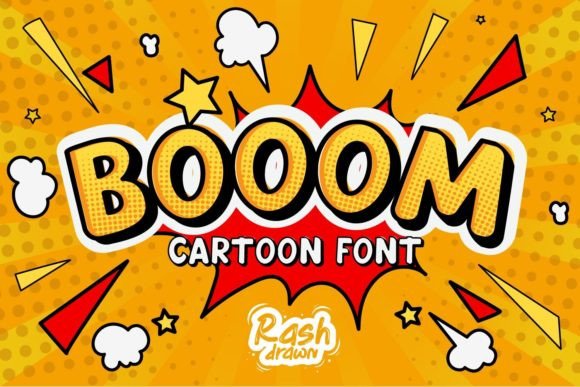
To understand why Booom works so well, we have to look at its construction. It is a bold display font that leans heavily into the aesthetics of pop art and retro cartoons. The letterforms are robust, often featuring thick strokes and rounded terminals that suggest motion and weight. It is not a rigid geometric sans serif font, nor is it a flowing script font. Instead, it occupies a unique space as a creative font that balances playfulness with structural integrity.
The personality of Booom is loud and confident. It carries a visual weight that commands attention immediately. When you look at the characters, you see a typeface that is designed to be seen, not hidden in a paragraph of body text. It is playful and strong, making it an ideal choice for projects that need to convey energy, excitement, or a sense of adventure. Whether you are working on a logo design for a new gaming startup or creating packaging design for a children’s toy, Booom brings a character that feels alive.
Where Booom Shines: Practical Applications
One of the most common questions I hear from clients and fellow designers is, "Where does a font like this actually fit?" The versatility of Booom is surprising. While it is technically a display font, its applications are vast across different industries.
Branding and Marketing
For entrepreneurs and small business owners, brand identity is everything. If your brand targets a younger demographic or wants to project a fun, approachable vibe, Booom is a strong contender. It works exceptionally well for logo design where memorability is key. Imagine a children’s party planning service or a retro arcade bar using this typeface. It instantly sets the tone. In marketing, headers and subheaders set in Booom can break up the monotony of standard sans serif fonts, guiding the reader's eye to the most important information.
Digital and Print Design
In the realm of web design and social media graphics, attention spans are short. You have milliseconds to grab a user. Booom serves as a powerful hook. It is perfect for hero sections on websites, call-to-action buttons, or YouTube thumbnails that need to pop on a crowded feed. In editorial design, such as magazine covers or poster layouts, it acts as a visual anchor. However, because of its bold nature, it is best used for headlines and pull quotes rather than long-form reading.
Publishing and Packaging
If you are in publishing, specifically in the comic book or graphic novel space, finding a font that mimics the energy of the artwork without looking cheap is difficult. Booom solves this. It has the authenticity of hand-lettering but the consistency of a professional typeface. For packaging design, particularly for snacks, beverages, or toys, the font’s ability to convey "fun" is invaluable. It helps products stand out on the shelf, suggesting that the contents are exciting.
The Psychology of Typography and Brand Perception
Typography influences how we feel about a product before we even use it. This is a core principle of modern typography. When you use Booom, you are signaling to your audience that your brand is energetic, creative, and perhaps a bit rebellious. It builds a specific kind of brand perception—one that is memorable and recognizable.
Consistency is another factor. By utilizing the full character set of Booom—including uppercase, lowercase, and special characters—you can maintain a cohesive visual language across all touchpoints. Whether it is a tweet, a business card, or a banner ad, the font creates a thread that ties your brand identity together. This recognition is crucial for building trust and professionalism, even when using a playful style.
Design Strategy: Pairing and Implementation
Using a high-impact font like Booom requires a bit of strategy. You cannot simply drop it into a layout and hope for the best. Here is how to get the most out of this design asset:
- Font Pairing: Because Booom is so expressive, it pairs best with something neutral and clean. A classic sans serif font like Helvetica, Open Sans, or a simple serif font like Georgia can provide the necessary breathing room. Let Booom handle the headlines while the secondary font handles the detailed information.
- Readability: Always test your font pairings at different sizes. Booom is designed for impact, so ensure that when scaled down for mobile devices, the special characters and lowercase letters remain distinct.
- Licensing: Before using Booom for commercial projects, review the commercial license. Ensure it covers your specific use case, whether that is for merchandise, digital products, or client work.
Ultimately, Booom is more than just a set of glyphs; it is a tool for storytelling. It allows designers, marketers, and creators to inject personality into their work instantly. If you are looking for a creative font that is cool, unique, and packed with character, Booom is a worthy addition to your typographic toolkit. It proves that sometimes, the best way to be heard is to be bold.